

Allah and Worship: When Your Child's Faith Isn't Where Yours Is
If your child is scared, resistant, questioning, distant, or over-zealous about Allah swt and worship, here's what's really going on.

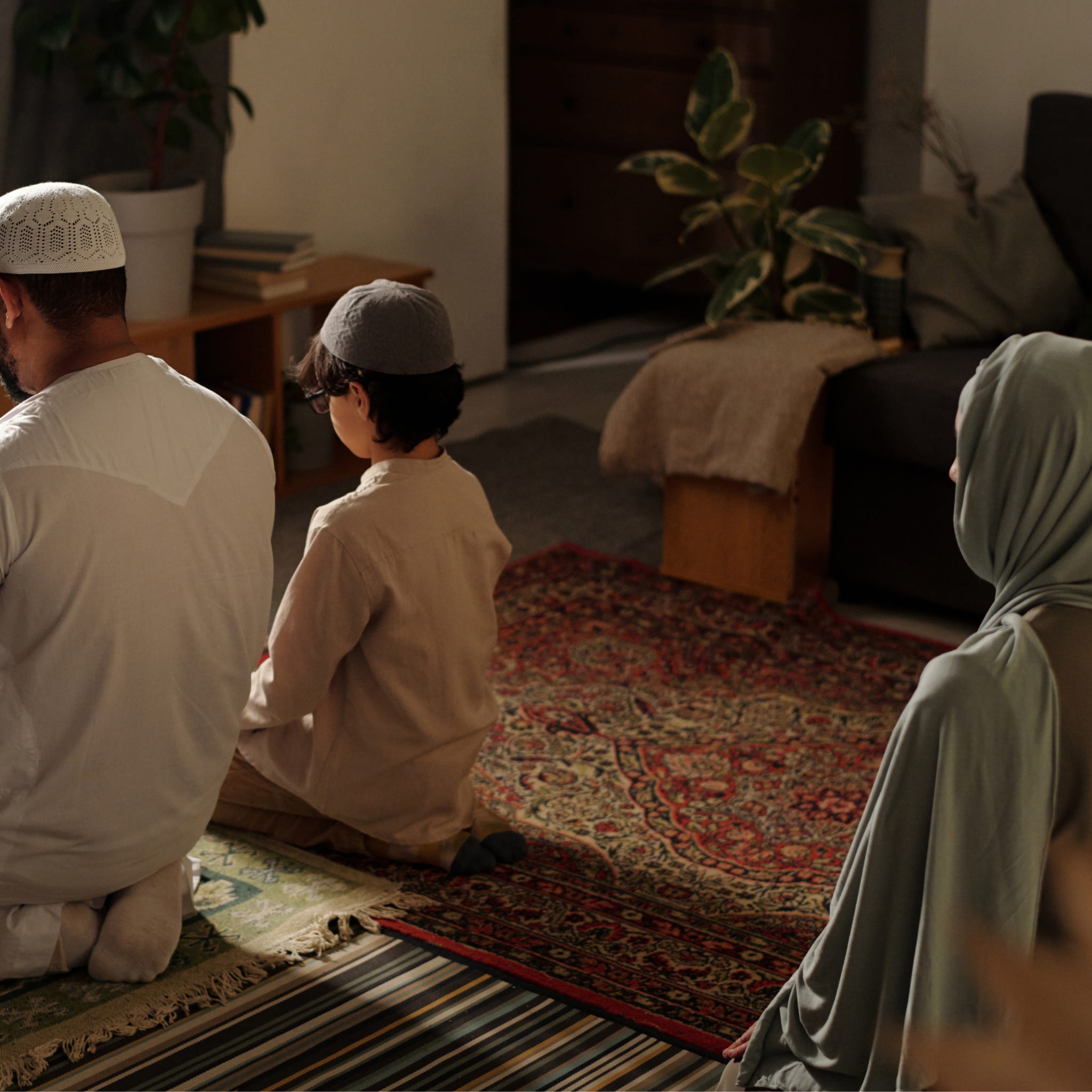
You pray, and you wonder if your child will too. You fast, and you wonder if your child will want to. You wear your hijab, sit in dhikr, give your charity quietly, and the whole time, somewhere in the back of your mind, a question is running on a loop.
Will my child love this the same way I do?
And there are moments when it feels like the answer is no.
The toddler who comes home from time with a relative, wide-eyed and quiet, asking you if Allah swt is angry with them. The seven-year-old who cries every time you say it’s time for salah. the eleven-year-old who looks you in the eye at dinner and asks why they have to be Muslim. The fifteen year old who used to love going to the masjid and now sits through Maghrib prayer with their eyes on the wall, their mind somewhere else. Or the older sibling who’s just started to pray consistently and is now telling younger siblings they’re going to hell because they’re not doing the same.
None of these moments mean that you’ve failed. But all them feel like you have.
The truth nobody says out loud.
This is the loud, unspoken truth of raising Muslim children. A parent’s iman doesn’t transfer automatically to their kids. It doesn’t move from your heart to theirs just because you want it to, because you pray for it, or because you’ve done everything you can think of to make it so. Your child has their own relationship with Allah swt to build. And like every relationship that’s worth having, it’s going to go through phases. It’s going to wobble, and it’s going to look different from yours because they’re not you.
What every conversation needs to start with.
Here’s what I want you to hold onto as you read the rest of this essay.
The Prophet ﷺ told us that when Allah swt completed the creation, He wrote in His book with Him upon the Throne,
"Verily, My mercy prevails over My wrath."
[Sahih al-Bukhari 7453, Sahih Muslim 2751]
That sentence is the foundation of every conversation you’ll ever have with your child about Allah swt. Not fear. Not punishment. Not the threat of what’ll happen if…
Mercy first. Mercy that arrives before anger ever gets a chance to. Mercy that’s build into the architecture of creation itself.
Every fear-based message your child has ever absorbed from anywhere else, the angry relative, the harsh teacher, the YouTube video, the off-hand comment they overheard, every one of those messages is the opposite of that single truth. And your job, in the years you have with your kids, is to make sure the truth gets to them louder and more often than the noise does.
The struggle though, is very real. Because the struggle has a different shape at every age.
Five faces of a child’s iman
The very young child who’s scared. Who’s heard that Allah swt is angry, that Allah swt doesn’t love bad children, that Allah swt punishes. They can’t always tell you that they’re scared, so they show you in different ways. They flinch when you mention Allah swt by name. They’re scared to make a mistake. They over-apologize when they do. They ask questions at bedtime that break your heart. “Am I going to hell, mama?”
The school-age child who resists doing what Islam requires of us. The crying at wudu, disappearing on hearing the call to prayer, shrinking away from anything that feels like an instruction - to pray or go to Qur’an class. This isn’t a child who doesn’t love Allah swt. This is a child whose nervous system is overwhelmed by the demands being placed on it, and whose only language for that overwhelm is no.
The tween who asks the hard questions. The ones that catch you off guard. “Why do I have to pray? Why can't I eat that? Why does Allah let bad things happen? Why am I different from my friends? Why do I have to live by a different set of rules?” This isn’t a child losing their deen. This is a child whose mind has just woken up to the possibility that the world contains contradictions. Their friends and teachers are kind, and the rules of their lives are different from the rules of their own, and they’re starting to notice. They’re bringing the hard questions to you because you are the safest place they know. The question is not the crisis. How you receive the question is.
The teen who’s gone distant, who still prays sometimes, but mechanically. They used to love the masjid but now drag their feet. They’re not rebelling outright, but the spark you used to see isn’t there anymore and you can feel it. This isn’t a child who’s abandoned Allah swt. This is a child whose heart is in a season, and whose season may not match yours.
And then there’s the child who’s gone the other way. The one who’s just discovered the beauty of consistent worship and is now standing over their younger siblings, demanding to know why they’re not doing the same. Telling them they’re bad, and they’re going to hell. This isn’t a child who’s become more religious. This is a child who’s confused enthusiasm with authority and who needs to be gently reminded that their job isn’t to enforce the path, but to make the path look beautiful enough that their sibling wants to walk it too.
Five different children. Five different seasons. Five different conversations.
And none of this happens in a vacuum
And here’s the part that needs to be highlighted. None of these conversations are happening in a vacuum either. They happen while you’re running on little to no sleep, while you’re trying to manage your own iman, which itself ebbs and flows in ways you don’t always understand. While you’re navigating a week of menstruation in the middle of Ramadan and trying to keep your kids motivated for tarawih when you can’t participate yourself. While you’re correcting something a well-meaning auntie said over the weekend that’s now taken up residence in your four-year-old’s mind. While you’re wondering if you’re getting any of this right at all.
And here’s the harsh truth.
Your job is the atmosphere, not the outcome.
Your child’s iman isn’t a project you’re managing. It’s a relationship they’re building with their Creator, in the conditions that you’re providing. You set the temperature of the home. You choose the words. You choose the response when the hard moment lands. You decide whether your child experiences Allah swt through you, as a source of warmth or a source of fear.
That’s really hard work, and it’s sacred work, but it’s not the same as being responsible for the outcome. The outcome belongs to Allah swt. The atmosphere belongs to you.
And the atmosphere is what your child will remember, long after they’ve forgotten the exact words you said. They’ll remember the feeling of being at home when faith was being talked about. Was it tense? Was it soft? Was it safe? Was Allah swt introduced to them as someone who loved them, or as someone they had to perform for? Was their parent visibly anchored in mercy, or visibly anchored in fear of what would happen if they slipped?
Children are hearing how you feel about Allah swt, not just what you say about Him.
These are seasons, and seasons end.
So if your child is scared of Allah swt right now, you’re not too late. If your child is resisting offering salah right now, you’re not failing. If your child is asking questions you don’t know the answers to right now, you’re not unequipped. If your child has gone distant right now, you’re not losing them. If your child has become harsh in the name of being more religious, you’re not watching them become someone you don’t recognize. These are seasons. And seasons end.
Your job isn’t to make their iman happen. Your job is to make your home the kind of place where iman, when it comes, has somewhere soft to land.
Where to go from here.
That is the why and the what. The how, the actual words for the actual moments, the scripts for each age, the troubleshooting for when those scripts don’t go the way you hoped, all of that lives in This Week At Home, the Friday paid release. If you’ve been on the fence about subscribing, this is the week. Because these are the moments where most of us go blank, and these are the moments your child will remember.
And on Wednesday’s companion podcast, I’m going to tell you the truth about what it’s been like in my own house, including the Ramadan nights I have spent on the sidelines while telling my kids to reach for the stars. That episode is going to be honest in a way these conversations usually aren’t. I hope you’ll come back for it.
May Allah swt make our homes places where mercy precedes everything, and may He place in our children a love for Him that outlives anything we are able to teach them. Ameen.
You’re doing better than you think. Share with another mama who can benefit.
With du’a,
Gulnaz
Halal Parenting